Sign up for The Rising Times newsletter and get this great information straight in your email!

Sent 05/15/2026May 15, 2026

YOU’RE INVITED!
WE’RE CELEBRATING LOCAL RIGHT NOW!

Come on over and join us at our spring 2026 Celebrate Local event, featuring our superstar local vendors, producers, and friends. Join us for a community meal (meat and vegan options), lots of delicious local samples, and the fabulous faces behind many local products. We will also have an adult beverage tasting inside the store, where more than 7,000 local products are 10% off all day (some exclusions apply). This free fun family event will take place, rain or shine, under our big tent. 

Everyone is welcome!

Bluet
Colvard & Co.
Devenish Wines
Fields Fields Blueberries
Green Bee
Heiwa Tofu
Herbal Revolution
Maine Gravy
Mbingo Mountain Coffee
Misty Brook Farm
Morning Dew Farm
Pleasant Ridge Provisions
Red Kettle Kimchi
Short Creek Farm
Sweet Monkey Business


FOOD TANK EXPLAINS: FOOD SOVEREIGNTY

By Jessica Levy, General Counsel and Senior Research Fellow at Food TankOriginal.

This article is part of Food Tank’s primer series, “Food Tank Explains.” Each installment unpacks the ideas, innovations, and challenges shaping today’s food and agriculture systems, offering clear insights into complex topics. To explore more articles in the series, click here.

Food sovereignty is the right of peoples, communities, and countries to healthy and culturally appropriate food produced through socially just, ecologically sound, and sustainable methods, and their right to define their own policies, strategies, and systems for food production, distribution, and consumption.

While food security names the destination, food sovereignty defines a democratic path to reach it. According to the U.N. Food and Agriculture Organization (FAO), food security is a condition in which everyone has reliable access to sufficient, safe, and nutritious food.

Food sovereignty accepts that objective but shifts the focus to power and governance, arguing that achieving lasting food security requires placing decision-making in the hands of the people who produce, distribute, and consume food, rather than markets or dominant governments.

Food sovereignty emerged in the 1980s and 1990s as a response and challenge to the social, economic, and environmental consequences of globalization and industrialized agriculture. 44 percent of the world’s population was living in extreme poverty in 1981, and the number of hungry people grew by 15 million between 1970 and 1980, even as surplus food flooded global markets.

Mechanization of agricultural tasks like sowing seeds, harvesting crops, milking cows greatly reduced and sometimes eliminated the need for human and animal labor, leaving many without jobs. The share of the U.S. workforce employed in agriculture fell from 41 percent in 1900 to 2 percent by 2000, and between 1950 and 1997 the average farm more than doubled in size while nearly half of farms disappeared.

The 1980s marked a sharp increase in global temperatures and, in 1988, NASA scientist James Hansen told Congress he was “99 percent sure” that global warming was upon us. Indigenous, rural, peasant, and small-scale farming communities were left facing overlapping crises of poverty, environmental degradation, and hunger.

Recognizing urgent necessity for an organized, collective, and internationalist response, La Via Campesina coined the term food sovereignty at the 1996 World Food Summit. A decade later, 700 delegates from five continents gathered at the 2007 International Forum for Food Sovereignty in Nyéléni, Mali to further deepen collective understanding on the topic, developing the six pillars of food sovereignty.

The framework centers food as a human need rather than a commodity, supports sustainable livelihoods for food providers, and localizes food systems and shortens the distance between producers and consumers. It places decision-making power in the hands of local communities, builds on traditional knowledge strengthened by research, and works with nature instead of industrial, energy-intensive models.

During Canada’s subsequent People’s Food Policy process, members of the Indigenous Circle added a seventh pillar, which states that “food is sacred,” asserting that food is a gift of life and must not be reduced to a commodity.

Nearly three decades after La Via Campesina introduced food sovereignty, the hunger, poverty, ecological degradation, and concentrated market power it sought to confront persist. Today’s industrial food system generates record levels of calories, yet nearly one-third of the global population remains food insecure. Food systems contribute up to one-third of global greenhouse gas emissions, and agriculture threatens more than 80 percentof species at risk of extinction.

Corporate consolidation has deepened across the food system, with four firms controlling nearly 70 percent of the global pesticide and seed market. And small-scale and family farmers comprise over 98 percent of farms, but control just 53 percent of agricultural land.

Beyond codifying the right to food and control over food systems, and recognizing the contribution of indigenous peoples, pastoralists, forest dwellers, workers and fishers to the food system, food sovereignty offers a framework to address the harms of industrial agriculture.

By localizing production and prioritizing agroecological methods, food sovereignty can shorten supply chains and reduce emissions while restoring soil health and biodiversity. Research also finds that food sovereignty–based approaches, such as strengthening school food systems, improving soil fertility, advancing gender equity, and confronting structural racism, can support long-term health equity.

Scaling food sovereignty requires structural reforms that confront concentrated power and expand equitable access to land. IPES emphasizes the need to democratize governance and counter corporate control of the food system through stronger conflict-of-interest safeguards, revitalized antitrust enforcement to reduce market concentration, and stricter transparency and lobbying rules.

Others like the National Young Farmers Coalition call for eliminating inequities in land ownership, protecting farmland, securing affordable land tenure, and supporting farm viability and transition.

“If people don’t control the food, they don’t control the power,” Morgan Ody, General Coordinator for La Via Campesina, tells Food Tank.

Articles like the one you just read are made possible through the generosity of Food Tank members. Can we please count on you to be part of our growing movement? Become a member today by clicking here.

Photo courtesy of Evan Rally, Unsplash


 OUR COMMUNITY THRIVES WHEN YOU LEAD

The Rising Tide Board of Directors is kicking off our search for new board members! Keep an eye on this newsletter for updates and deadlines. Want to learn more, grab an application, or just want to say hi? Come see us at Celebrate Local on May 15!  

Questions? Email deb.s@risingtide.coop

ALL MONTH!


Every month, we donate .5% of our Wednesday sales to an organization nominated and voted on by our member-owners. That organization is also invited to come into Rising Tide and present information and takeaways for the public to be educated and aware of this organization’s efforts within our community. 
MAY’S PARTNER:

The Newcastle Ecumenical Food Pantry has been serving the Midcoast area since 1989- primarily the towns of Newcastle, Damariscotta and Nobleboro, but they do not turn anyone away.

The Ecumenical Food pantry was founded in 1989 by Ruth Ives and Gail Berry. Today it is the cooperative effort of 8 area churches and completely volunteer run, with the goal of addressing food insecurity locally.

They are open every Tuesday from 9:00 AM – 11:00 AM for market-style shopping.

newcastlefoodpantry.org


TOMORROW


TWIN VILLAGES ARBOR DAY CELEBRATION

Help us grow our community canopy! Coastal Rivers is teaming up with the Towns of Damariscotta and Newcastle for the annual Twin Villages Arbor Day Celebration! Join us on Saturday, May 16, for a morning dedicated to local trees and family fun.


FROM OUR FRIENDS AT SKIDOMPHA LIBRARY
Want to expand your palette, but don’t know where to start? Hate buying a whole jar of a spice you’re not even sure you’ll like? Try Skidompha’s new Spice of Life Collection! Starting the first Tuesday of each month, patrons will be able to take home a sample of the highlighted spice, two recipes on how to use it, and a suggested reading/history guide. All spices are donated by our kind sponsors at Rising Tide Co-op.


AUTOMATIC ROUND UP
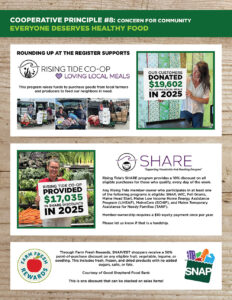
As a member-owner you have the option to round up at the register every time, without being asked. Talk to a front end team member, click on the graphic below, or email Shannon at outreach@risingtide.coop if you would like to set this up. Thanks!


SUPPORT LOCAL

* indicates required